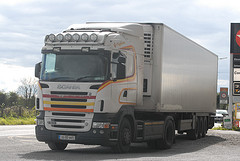
 Logistics are the backbone of most firms. They ensure that products and services are delivered in a timely fashion and keep the whole business ticking over. As logistics are such a vital part of a business, they must be both efficient and cost-effective.
There are many ways in which logistics can waste a firm’s money, but there are also many ways in which money can be saved. These range from voice picking to asset labelling and tracking of goods.
Vehicle tracking systems and Radio Frequency Identification Devices (RFID’s) are both ways of keeping track of your fleet.
They both track where each vehicle is in real time, via the use of GPS signals. The data that these systems can provide gives companies the potential to become more efficient and save money at the same time.
Wireless Matrix is one business that specializes in providing GPS tracking to commercial fleets.
For example, they allow firms to observe the route that each vehicle takes on each particular trip. This information can then be used to see if the drivers are choosing either the quickest or the most economical route.
By using the most economical route possible then the company will save both in terms of fuel costs, and as well as this they will also reduce their carbon emissions.
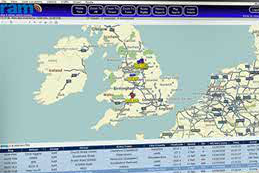 These devices can also be used to monitor driving styles over time. Some drivers may have developed bad habits which waste fuel without even noticing, and RFID’s and tracking systems enable them to identify these issues, and offer new training to those drivers who don’t realise they are costing the company excess money.
Another valuable benefit of systems such as these is the issue of drivers driving for too long without breaks. By law, drivers of heavy goods vehicles must take a break from the wheel every four and a half hours, for at least forty-five minutes at a time. Failure to do so increases tiredness at the wheel and the possibility of accidents and crashes increases exponentially.
It is now possible for managers to see how long each driver has been driving for at one time, and avoid any drivers exceeding the time they are allowed to stay at the wheel.
Trackers can also be used to ensure that stock inventories are kept at an optimum level by storing information on their length of time in storage and their overall sales history. This is especially useful for those who transport perishable goods.
In the same way, RFID trackers can be used to help track vans through radio-communicated signals. Van tracking is an excellent way to make large freight vehicle or smaller van deliveries more efficient. By ensuring that vehicles and their goods are properly tracked from a warehouse to their delivery, a business can reduce levels of acceptable loss and raise overall performance levels.
Moreover, RFID software can be used to record successful deliveries and to report any recurring problems in terms of transportation. Having these tracking devices in place ultimately means that a self-employed business can better monitor and improve efficiency and long-term profit margins.
Therefore, through the use of vehicle tracker systems and RIFD’s, companies can improve their efficiency, reduce their levels of waste, cut costs, and as a result, see profits increase, in addition to lowering carbon emissions and helping reduce dangerous accidents.
In logistics, many problems happen because companies do not know two important things clearly.
First, they do not know where the vehicle is.
Second, they do not know where the goods or assets are.
This is where vehicle tracking systems and RFID can help.
A vehicle tracking system helps a company know where its trucks, vans, or delivery vehicles are in real time. It can also help with route planning, driver monitoring, and delivery timing.
RFID is different. RFID helps a company track items, pallets, boxes, tools, or tagged assets when they move from one place to another. This is useful in warehouses, loading areas, gates, and logistics hubs.
When these two technologies are used well, they can improve logistics in a big way.
Why these systems matter
Many logistics problems are caused by poor visibility.
For example:
- A truck arrives late, and nobody knows why
- Goods are missing, and staff cannot trace where they were last seen
- Warehouse staff waste time searching for tagged items
- managers do not know which vehicle is moving, waiting, or underused
Vehicle tracking and RFID can reduce these problems. They help companies work faster, make fewer mistakes, and improve control.
Now let’s look at a few systems that can help.
1. Samsara
Samsara is a strong system for vehicle tracking and fleet management.
It helps companies see where their vehicles are, manage routes, monitor drivers, and track fleet operations. It is useful for businesses that want better control over trucks, vans, and transport movement.
Good points
- Real-time vehicle tracking
- Better route and dispatch control
- Can improve fleet visibility
- Helpful for maintenance and driver monitoring
Not so strong
Samsara is more focused on vehicles and fleet operations. If your company also wants deep RFID tracking inside the warehouse, Samsara alone may not be enough.
2. Geotab
Geotab is another well-known system for fleet tracking and data reporting.
It is good for companies that want to understand how their vehicles are moving and how the fleet is performing. It can help with route improvement, trip records, and delivery management.
Good points
- Strong GPS vehicle tracking
- Useful reports and data insights
- Good for delivery and transport businesses
- Can help improve efficiency
Not so strong
Like Samsara, Geotab is more about vehicle tracking than item-level RFID tracking.
3. Zebra Technologies
Zebra is a strong choice for RFID and asset visibility.
This is useful when the company wants to track not only vehicles, but also goods, pallets, packages, and warehouse assets. Zebra is more suitable when the business wants better visibility inside logistics operations and warehouse movement.
Good points
- Strong RFID solutions
- Good for warehouses and logistics hubs
- Helps track tagged assets more clearly
- Useful for large operations
Not so strong
Zebra can be more complex to set up. It may need planning, hardware placement, and proper process design. So it is powerful, but not always simple.
4. ORBCOMM
ORBCOMM is useful for companies that want to track trailers, containers, and yard assets.
This is a good fit when the logistics business has many transport assets outside the warehouse, especially assets that are moving between locations or waiting in yards.
Good points
- Good for trailer tracking
- Useful for container visibility
- Helps monitor transport assets
- Suitable for yard operations
Not so strong
If the company mainly wants RFID for pallets, boxes, or warehouse goods, ORBCOMM may not be the main solution.
5. JADAK
JADAK is interesting because it connects RFID with vehicle and logistics tracking.
This makes it useful for companies that want RFID-based tracking in transport and logistics work. It can help with package tracking, vehicle-related RFID use, and asset visibility.
Good points
- RFID-based logistics tracking
- Can support vehicle-related tracking
- Useful for package and asset monitoring
- Good for more specialized RFID needs
Not so strong
This may be a more specialized type of solution, so the company must be clear about what problem it wants to solve.
Which type of system is best?
The answer depends on the problem.
If your problem is knowing where the vehicle is
These systems are stronger:
- Samsara
- Geotab
- I-Tracking
If your problem is knowing where the goods or assets are
These systems are stronger:
- Zebra
- JADAK
If your problem is tracking trailers, containers, or yard assets
A system like this is more suitable:
- ORBCOMM
Key takeaways
If a company wants to improve logistics, it should not just ask, “Which software is best?”
That is too vague.
The better question is:
What exactly are we trying to track?
Is it the vehicle?
Is it the goods?
Is it the pallet?
Is it the trailer?
Or is it all of them together?
Vehicle tracking systems help companies see movement on the road. RFID helps companies see the movement of assets and goods in operations. When both are used in the right way, logistics can become faster, clearer, and more efficient.
So the real value is not only in buying a system. The real value is in choosing the right system for the right logistics problem.





Leave a Comment