
Utilizing staff augmentation allows businesses to increase their engineering capabilities quickly without lengthy hiring processes while still maintaining complete oversight of their product development projects. Hiring through this model will give you access to specialized workforce resources as well as make your teams flexible enough to adapt easily to change.
The way to achieve this type of capability in 2026 is through the increased use of the staff augmentation model as a standard in organizations to increase their speed and flexibility.
Leaders in technology and software development are under continuous pressure to produce more quickly, but they cannot compromise on quality when developing their products. Space lost due to hiring can slow down an organization, while complete outsourcing will result in a lack of control over product outcomes. Staff augmentation solves both issues by providing additional external engineers for your organization’s internal development teams who will continue to deliver within the same existing development processes.
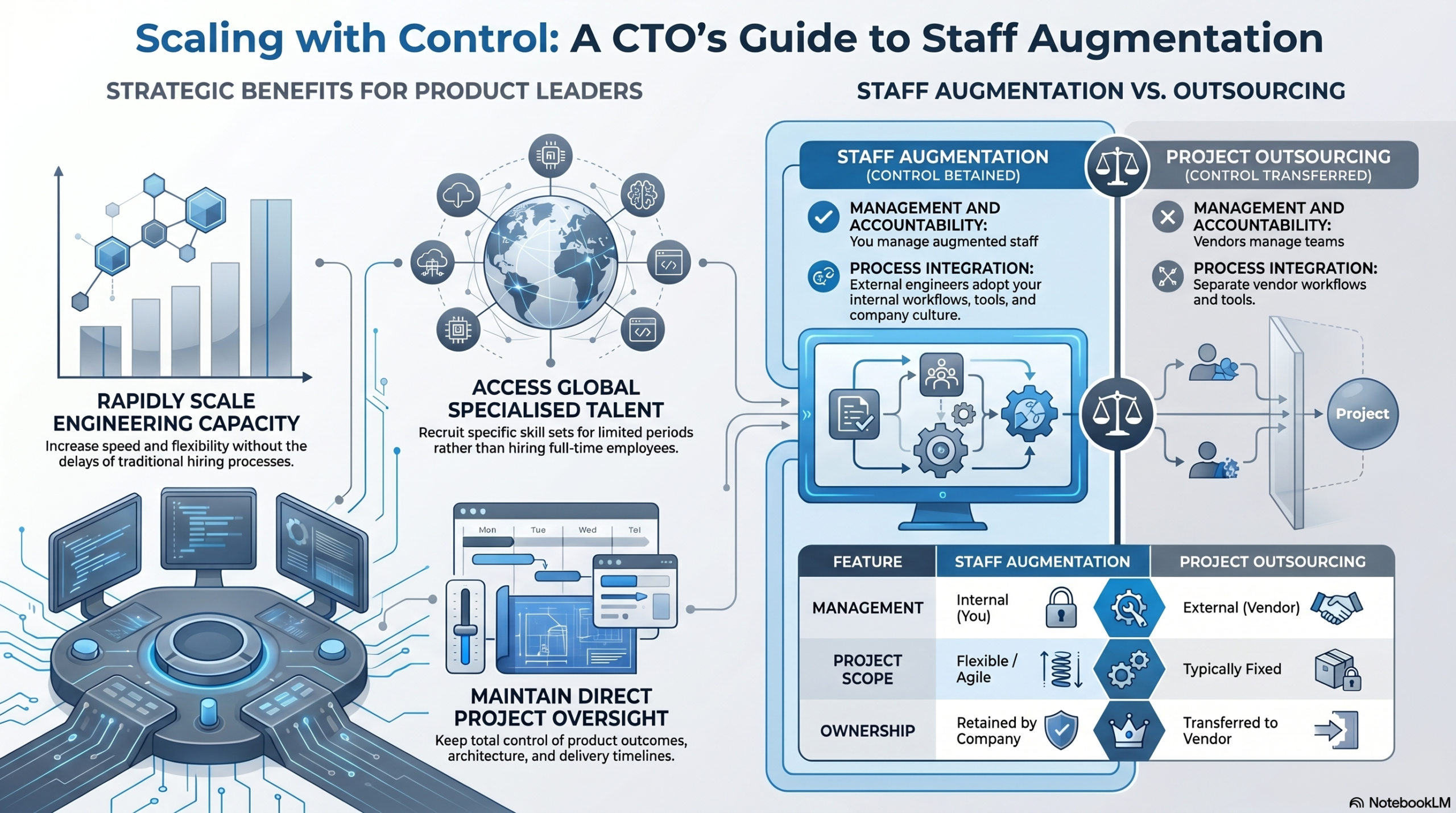
What is staff augmentation
Staff augmentation is the addition of external developers to your internal team. The external developers (or Augmented Staff) will work with you in the management capacity of your Team. The external engineers will have access to your tools and processes, and will add to the development of your product.
The key difference from outsourced engineering is that the ownership of development is retained by your company. You are responsible for setting priorities, defining your architecture, and creating timelines for delivery. External engineers are only used for executing the development activities, and cannot take control of the overall project.
Staff augmentation is a good process for supporting product companies that have a continuous amount of development and a quick turn-around for the next release.
Why staff augmentation matters for CTOs and product leaders
CTOs and product leaders must balance delivery speed with long-term system quality. Hiring delays create bottlenecks. Skill gaps slow down development. At the same time, handing over projects to external vendors limits flexibility.
Staff augmentation provides a controlled way to scale teams. It allows companies to bring in engineers with the right expertise at the right time. This becomes critical when launching new features, entering new markets, or scaling infrastructure.
Many organizations rely on a structured team augmentation services model to quickly access vetted developers who can integrate into internal teams without long onboarding cycles.
How staff augmentation works in practice
Initially, the necessary roles and skill sets needed by the organization must be established. A company chooses the developer types and matched skill sets required and how these roles will add value to the product.
After entering the organization, selected developers will join internal teams and work through employment processes already in place. Developers will engage in meetings including: daily standups, sprint planning, and development cycles along with internal engineers.
Ultimately, the degree to which external developers positively impact an organization’s product development depends on how aligned they are with internal processes, allowing the team to ultimately function as “one team.”
Benefits of staff augmentation
Companies can use staff augmentation as a tool to give them flexibility in how they manage their engineering resources, including how they scale their teams up or down during periods of active development or a shift in priorities. Staff augmentation also increases access to talent; companies can hire engineers with the exact skills needed for the job, rather than being limited by local talent pools. Finally, staff augmentation allows for much faster contributions by the experienced developer, which helps to reduce delays in project timelines and expedite the delivery of products to the market.
Control of the project stays with the company, ensuring that product decisions are aligned with the overall business goals and reducing the risk of product-related decisions made by an external entity.
When to use staff augmentation
In rapidly changing environments, Staffing Augmentation is the most beneficial as needs will fluctuate. It provides support for continuous product improvements and Agile methodology.
It also helps to bring in specialised skills that are only required for a limited amount of time as opposed to providing full-time employees with these skill sets.
The use of this model means that a company may grow while being able to scale their business without any additional operational complexity.
Staff augmentation vs outsourcing
How a project is managed will change depending on if you choose to use staff augmentation or outsourcing as a method of delivering your project.
When outsourcing, responsibility is transferred from the company to the vendor who is responsible for managing the team and delivering against the agreed-upon requirements. Therefore, outsourcing is appropriate for projects with a fixed scope.
With staff augmentation, the company retains the responsibility of managing the contractors. The extended team members will work as part of the internal staff, utilizing established processes of the company. This allows for more rapid change and better alignment to the product’s direction.
For an organization focused on product development, this type of control is often essential.
Challenges of staff augmentation
Effective staff augmentation requires appropriate management.
Aligning an external developer’s onboarding process can be a difficult challenge, as external and internal developers must align with corporate processes/workflow and be part of the same team culture to drive productivity.
Communication will be crucial to the success of augmented developer projects. Projects with remote developers must be coordinated through consistent communication channels to prevent misunderstandings.
Increased management overhead for the internal teams who are coordinating the external developers with the internal development team and aligning the external developers with product goals must be considered.
How to manage augmented teams effectively
Clear expectations are essential for successful management. Every developer needs to be aware of the responsibilities and expectations expected of them as a member of the team.
Maintaining alignment between developers and the team should occur through regular communication. Daily meetings and feedback sessions provide developers with the opportunity to be kept up-to-date.
Having clear documentation will contribute to efficiency. Developers are confused when there are unclear requirements or unclear technical communications, and thus this will help reduce confusion and provide consistency.
Leadership is critical in this area. Product leaders and CTOs must ensure that the development teams are delivering on business objectives.
Nearshore vs offshore staff augmentation
The decision of whether to utilize a nearshore or an offshore model will likely come down to business priorities.
Because of the proximity of time zones, nearshore staff can communicate with customers in real time, resulting in greater speed of delivery, and less delay in project execution.
Offshore staff usually charge lower hourly rates for their services; thus, offshore workers have access to a much larger talent pool. However, the differences in time zones can create challenges with communication by creating longer lead times; therefore, nearshore staff will typically utilize more structured processes when communicating with clients.
Ultimately, the company’s priorities will determine the level of importance attached to the collaborative speed at which work must be completed.
Cost structure of staff augmentation
Using staff augmentation can lead to many of the traditional costs associated with hiring not being incurred. There is no need for companies to make investments in recruitment and long-term employees; those costs are eliminated. When determining costs, however, cost should be compared based on productivity. Communication issues may have an impact on delivery speed and thus affect the total expense of using someone who has a lower hourly rate but ultimately provides higher total value.
To find out the best way to measure the cost of using the contract staff is to compare how much you paid to receive back the results received.
How to choose the right staff augmentation partner
The success of the engagement will depend heavily upon the partner selected. In selecting a partner, it is important for companies to evaluate the potential partner’s technical capacities, communication skills and their ability to be integrated into existing teams. Partnering with a vendor that has previous experience with relevant applications reduces implementation risk and accelerates event delivery.
Utilizing client feedback and experience through case studies provides valuable insight into a Vendor’s overall performance during the engagement. Engaging in open and honest discussions regarding processes, pricing, etc., enables the facilitation of strong collaboration between all parties involved in the engagement.
Ultimately, the objective is to locate a business partner that provides a “Win-Win” to both parties and adds value to the business in relation to both Technical Delivery and achieving Business Goals.
Future of staff augmentation
Because of the increasing popularity of flexible working models, there is a continued increase in the use of staff augmentation by nanotechnology companies. The use of global talent is becoming commonplace among many companies.
While the use of artificial intelligence (AI) tools can increase productivity, experienced engineers are still necessary to design scalable systems and make sound technical decisions.
Increasingly, hybrid teams (those that utilize both internal developers and external developers) are becoming the standard. This hybridised model provides companies with both flexible and stable development options.
Final thoughts
Modern product development relies on staff augmentation as an essential strategy. This option allows organizations to grow their teams, gain access to international expertise, and have funding and influence over their products.
CTOs and product leaders can use this approach to build flexibility without giving up their jurisdictions. By collaborating with external resources in a staff augmentation type of relationship, companies will see quicker product delivery while still meeting their overall business objectives.
There are many benefits associated with using staff augmentation; companies that successfully do so increase delivery speed, lower risk, and develop systems that positively impact their long-term scalability.





Leave a Comment